Industrial Ionization Odor Control Systems for H2S, NH3 and VOCs
ZZGL-series DBD modules (2K–30K, 2,000–75,000 m³/h) generate active oxygen clusters at 7+ eV-class energy for odor, TVOC, and H₂S/NH₃ control—optional TiO₂ mesh and carbon polishing for WWTPs, transfer stations, labs, and industrial exhaust.
Send request
Ionization system selection for H2S, ammonia and VOC odors
Zhengzhou Enviro Solutions supplies high-energy ion deodorization systems based on bipolar shielded dielectric-barrier discharge (DBD) technology—engineered for municipal and industrial odor streams with optional photocatalytic and activated-carbon polishing stages.
Technology overview
Bipolar shielded ionization (DBD)
The process generates active oxygen atom clusters in the gas phase under controlled discharge conditions, avoiding uncontrolled UV exposure and minimizing excess ozone compared with conventional corona approaches when properly designed.
Cluster chemistry (indicative)
Clusters on the order of 10–60+ atoms per aggregate are cited for field designs, with indicative ~2.5 h lifetime in air under typical dilution—actual values depend on humidity, background gases, and mixing.
Key process steps
- Oxygen molecules are energized and charge-separated in the DBD zone.
- Magnetized / polarized oxygen clusters form and propagate into the bulk gas.
- Clusters persist long enough to contact odor molecules before relaxation (order of hours under reference conditions).
Treatment effects
- Odor species are oxidized, neutralized, inactivated, or removed by coupled filtration.
- Designs target deodorization with ancillary disinfection where airflow and contact time support it.
- Engineering emphasis: no dedicated UV lamp stage, no excess ozone, and no harmful oxygen-family by-products beyond controlled design limits.
Custom engineering
Module count, optional TiO₂ mesh and carbon stages, materials (SS304/316, FRP), and integration with scrubbers or biofilters are matched to concentration, particulate load, and permit requirements.
Technical introduction
Process workflow
Odor inlet → Pre-filtration → High-energy ion reaction zone → Photocatalytic mesh (optional) → Activated carbon filter (optional) → clean air discharge.
Ionization mechanism
- Oxygen ionization—electron energies on the order of 7+ eV in the active discharge.
- Cluster formation—10–60+ atom aggregates.
- Attack phase—high oxidation potential toward odor precursors.
- Breakdown—progressive oxidation toward mineralized products.
- End products—primarily CO₂, H₂O, and low-toxicity residuals under design conditions.
Reaction equation (simplified)
Odor molecules + O₂⁺ / O₂⁻ (ion clusters) → CO₂ + H₂O + harmless compounds
Target pollutants
- Xylene (C₈H₁₀)
- General odor compounds
- TVOC
- Methyl mercaptan (CH₃SH)
- Hydrogen sulfide (H₂S)
- Formaldehyde (HCHO)
- Ammonia (NH₃)
- Bacteria and viruses
Indicative removal efficiency
| Pollutant | Efficiency (ref.) |
|---|---|
| Xylene | 96% |
| Odor compounds | 90% |
| TVOC | 83% |
| Methyl mercaptan | 90% |
| H₂S | 86% |
| Formaldehyde | 85% |
| Ammonia | 80–88% |
| Bacteria / viruses | 90–95% |
Product classification
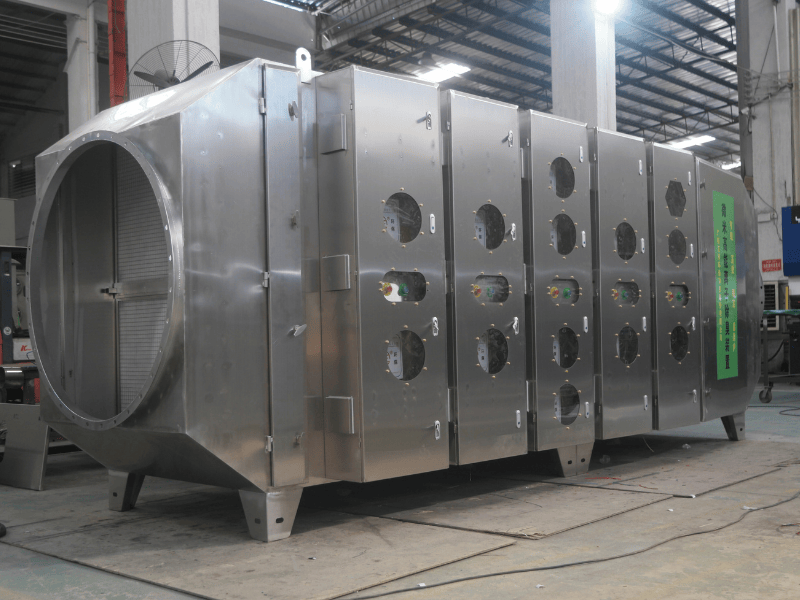
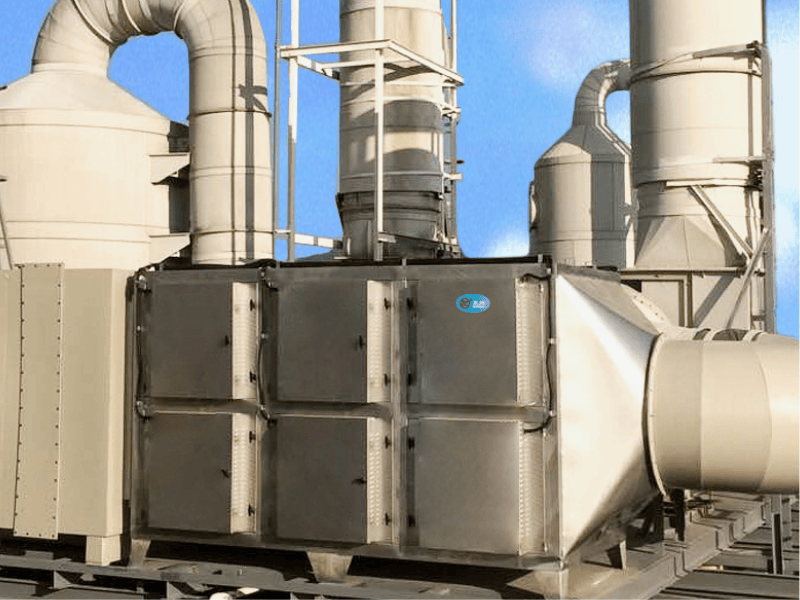
ZZGL series — high-energy ion deodorization
Model span: ZZGL-2K–ZZGL-30K. Flow range (reference): 2,000–75,000 m³/h. Power: ~100 W per module (typical).
| Model | Flow (m³/h) | Footprint | Voltage | Power | Material | ΔP |
|---|---|---|---|---|---|---|
| ZZGL-2K | 2,000 | Per design | 220 V | Per module | SS304 | 260–300 Pa |
| ZZGL-5K | 5,000 | Per design | 220 V | Per module | SS304 | 260–300 Pa |
| ZZGL-10K | 10,000 | Per design | 220 V | Per module | SS304 | 260–300 Pa |
| ZZGL-15K | 20,000 | Per design | 220 V | Per module | SS304 | 260–300 Pa |
| ZZGL-20K | 35,000 | Per design | 220 V | Per module | SS304 | 260–300 Pa |
| ZZGL-25K | 50,000 | Per design | 220 V | Per module | SS304/316 | 260–300 Pa |
| ZZGL-30K | 75,000 | Per design | 220 V | Per module | SS304/316 | 260–300 Pa |
Standard package components
- Wideband high-energy ion modules (2 sets, typical)
- Electronic control enclosure (1 set)
- TiO₂ photocatalytic mesh (1 set, when ordered)
- Activated carbon filter stage (1 set, when ordered)
- Integrated start/stop pushbutton with indicator
- Two-stage earth-leakage protection
- High-temperature protection
- Knob-type power adjustment
Module specifications (reference)
- Voltage: 220 V; single-module power: ~100 W
- Electron energy: 7+ eV; high-frequency pulsed discharge
- Discharge points: ~10× conventional layouts (design claim)
- Effective electron impacts per molecule path: 100+ in the reaction zone (design basis)
- Cluster lifetime in air: ~2.5 h (indicative); equipment life: 30,000+ h
Setting configuration and structure
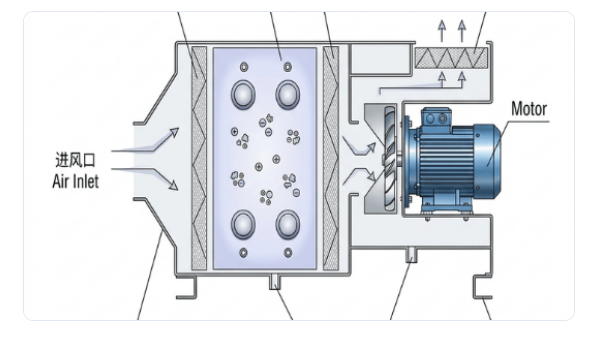
Equipment structure
- Pretreatment—prefilters, flow distribution plate, flow straightener
- Ion reaction zone—bipolar shielded tubes, HV/HF supply, cluster generation
- Photocatalytic stage—TiO₂-coated mesh (optional)
- Filtration—activated carbon capture stage (optional)
- Controls—enclosure, start/stop, power knob, status lamps
Standard configuration
- Main housing — SS304; ion modules (2 wideband sets typical)
- Integrated control box; TiO₂ mesh; carbon mesh when specified
- Safety — dual leakage + overtemperature; flanged inlet/outlet; access doors
Installation arrangements
- Single unit — commonly ≤30,000 m³/h duty class
- Parallel trains — higher flow or redundancy
- Series arrangement — high odor load or staged oxidation
- Hybrid — ion + biofilter + scrubber; ion + UV + carbon (engineered case-by-case)
- Drawer-style modular service for tubes and media
Material selection
Main structure
- SS304 — standard industrial service
- SS316 — aggressive / chloride-rich environments
- Coated carbon steel — budget-driven projects
- FRP — acid/alkali wet zones when integrated with scrubbers
Ion module materials
- Quartz tubes with dielectric coating; molybdenum / stainless electrodes
- Ceramic and engineered polymer insulation for HV
- SS304 module shells; indicative life 30,000+ h with correct operation
Filter media
- Prefilters — G4/F7 class; replace every 1–3 months (dust dependent)
- TiO₂ mesh — 1–2 year replacement typical
- Impregnated activated carbon — 6–12 months typical
Selection criteria
Gas chemistry, temperature, humidity, corrosion potential, capital vs. lifecycle cost, maintenance access, and electrical safety class drive alloy grade and module count.
Technical characteristics
Performance summary
Xylene ~96% (94–98% band); general odor ~90% (85–95%); TVOC ~83% (80–90%); CH₃SH ~90%; H₂S ~86%; HCHO ~85%; NH₃ 80–88%; microorganisms 90–95% (85–98% band). Pressure drop: 260–300 Pa (200–350 Pa). Power: ~100 W/module.
Module characteristics
7+ eV class electron energy; high discharge point density; 100+ effective impacts per molecule path in the active zone; clusters 10–60+ atoms; ~2.5 h indicative lifetime in air; 220 V operation.
System design inputs
- Inlet temperature <80°C; dust after prefilter <150 mg/m³
- Relative humidity <100% RH; avoid sticky aerosols without pretreatment
- Standard two-module configuration; knob power control; drawer maintenance
Safety parameters
- Two-stage leakage protection; overtemperature shutdown
- Over/under-voltage and short-circuit protection; verified equipment grounding
- Emergency stop; running/fault indication
Main features and advantages
Core features
- High odor removal (>90% reference); DBD bipolar shielded design
- Low electrical duty per module (~100 W @ 220 V); 30,000+ h hardware life target
- Modular drawer service; parallel/series flexibility; simple operator interface
- No intentional UV stage, controlled ozone, no harmful oxygen by-product emphasis
- Deodorization with disinfection side benefits; SS construction; 260–300 Pa ΔP
Advantage themes
High efficiency, low energy, environmental compatibility, long service life, broad applicability, stable operation, low maintenance, safe interlocks, compact layout, low OPEX, and rapid site installation.
Cost and lifecycle
CAPEX low-to-moderate versus large thermal systems; OPEX dominated by modest electricity and periodic media; modules rated 30,000+ h before major refresh.
Technology comparison
| Traditional ionization (risks) | Zhengzhou high-energy ion DBD |
|---|---|
| UV exposure, excess ozone, and reactive oxygen species concerns in poorly controlled designs. | Engineered DBD path: no dedicated UV lamp, controlled ozone, emphasis on human-safe operation and minimal harmful oxygen-family residuals. |
| Lower discharge density; fewer effective electron-molecule interactions. | 7+ eV class energy; ~10× discharge point density claim; 100+ impacts per molecule path in the reaction zone. |
Application fields
Industries
- Wastewater — pump stations, aeration, sludge handling
- Tanks and equalization basins; waste transfer stations
- Biological reactors; paint / coating plants; livestock and slaughter
- Rubber and plastics; food and beverage; feed mills; pharmaceutical production
- Laboratory fume exhaust
Pollutant capability (summary)
C₈H₁₀ (~96%); general odor (~90%); TVOC (~83%); CH₃SH, H₂S, HCHO, NH₃ as tabulated; bacteria, viruses, mold spores (90–95%); PM10 reduction 80–90% with pretreatment/filtration.
Project evidence
Project names, airflow and measured results are supplied only when they can be checked against the project record and client-name usage is permitted. Request a relevant reference package through the engineering enquiry form.
Applicable standards
- GB 16297-1996 — Integrated emission standard of air pollutants
- GB 14554-93 — Odor pollutant emission standard
- GB 3095-2012 — Ambient air quality standard
- DB 44/27-2001 — Guangdong emission limits (where applicable)
- GBZ 2.1-2019 — Occupational exposure limits
Pretreatment requirements
- Particulates <150 mg/m³ after prefilter; inlet <80°C
- Humidity <100% RH; no sticky condensable mist without demisting
- Avoid strongly corrosive spikes incompatible with SS/FRP selection
System integration options
Combined trains
- Pre-filtration + ion; scrubber + ion; biofilter + ion
- Activated carbon + ion; UV + ion; multi-stage ion
Control functions
- Central control enclosure; illuminated start/stop; power knob
- Leakage and overtemperature interlocks; fault alarm; emergency stop; status lamps
Maintenance guidelines
Routine plan
- Monthly — prefilter inspection
- Quarterly — ion module visual and electrical check
- Semi-annual — photocatalytic mesh review; electrical torque and safety test
- Carbon stage — replace from breakthrough monitoring and loading; complete an annual system audit
Operating best practices
- Hold T, dust, and RH within design; avoid sticky aerosols
- Replace prefilters on schedule; log service; train staff; stock filters and spare modules
- Monitor power draw for early fault detection
Module care
| Recommended | Avoid |
|---|---|
| Maintain rated voltage; keep pretreatment effective; periodic inspection; verified grounding; gentle non-abrasive cleaning; dry storage for spares. | Overvoltage; high dust without filters; ignoring performance drift; ungrounded service; abrasive or wet-handling damage. |
Figures and numeric bands are typical engineering references; certified drawings and test reports are issued per contract.