Smoke and dust removal equipment for particulate matter control
ZZMCB pulse bag filters (24–440 bags, 2,000–31,680+ m³/h) and ZZJD wet ESPs (5K–60K, 72 kV DC) capture dry dust, smoke, and mist—integrated with cyclones, cooling, and scrubbers for cement, mining, metal, food, and power applications.
Send request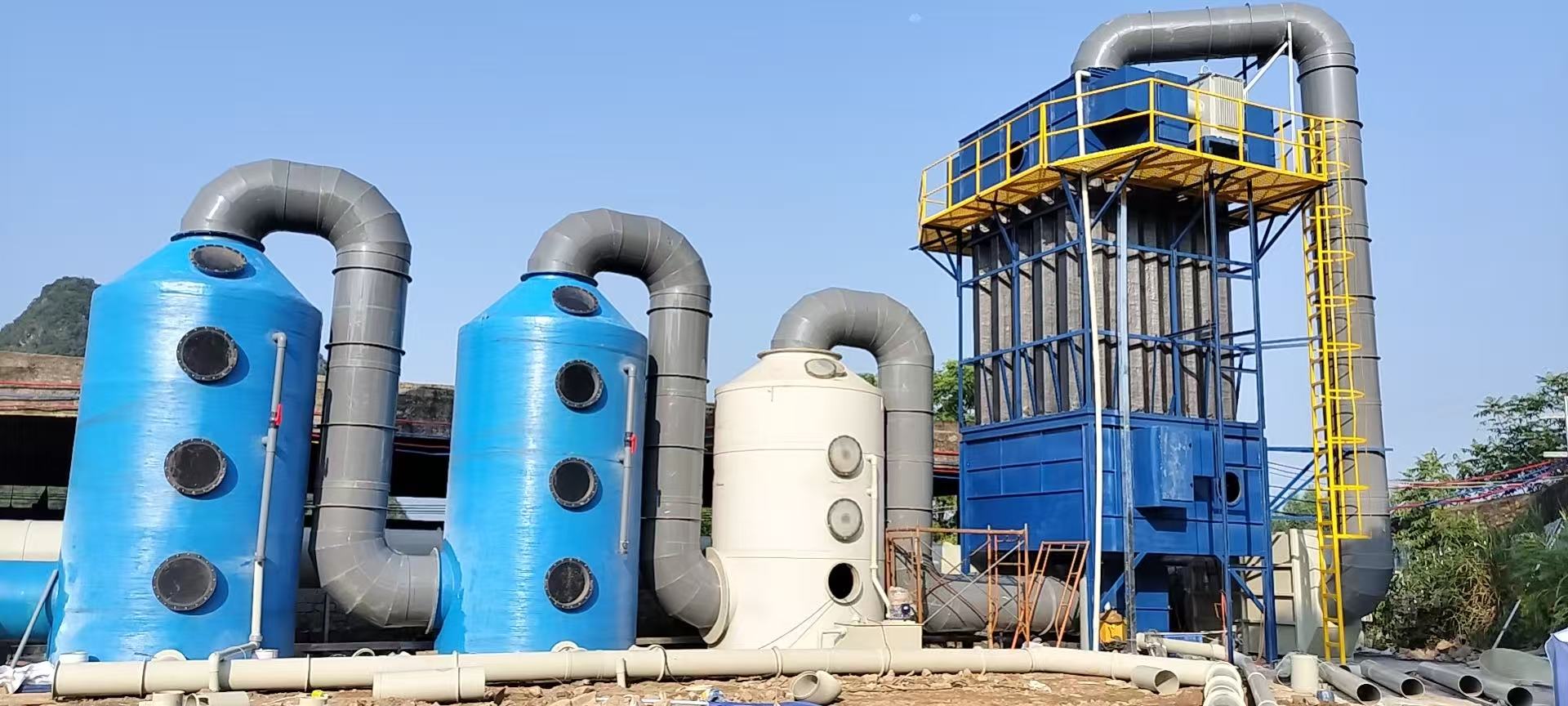
Smoke and dust removal equipment for particulate matter control
Zhengzhou Enviro Solutions supplies dry pulse-jet bag filters and high-voltage wet electrostatic precipitators (WESP) for coarse through ultrafine particulate, smoke, and mist—engineered for recovery, compliance, and safe handling of combustible dust where applicable.
Technology overview
- Pulse bag filtration—surface and cake filtration on woven/felt media with timed pulse cleaning.
- High-voltage wet ESP—ionization in a wetted field; charged droplets and particles migrate to grounded collectors and are flushed.
Key process
- Dust-laden gas enters the collector.
- Particles are captured on bags or in the ESP electric field.
- Clean gas exits the stack or fan suction.
- Dust is discharged via screw/conveyor or wet slurry, often automated.
System families
- ZZMCB series—pulse bag houses for dry dust and granular solids.
- ZZJD series—wet ESP for mist, smoke, and fine/submicron particles in saturated or scrubbed streams.
Custom engineering
Air-to-cloth ratio, bag materials, explosion protection, pre-cyclones, cooling, scrubber integration, and WESP electrode geometry are matched to dust properties, temperature, moisture, and emission limits.
Technical introduction
Process workflows
Pulse bag: Dusty gas → inlet plenum → hopper → filter bags → clean air plenum → outlet → pulse jet cleaning → dust discharge.
Wet ESP: Mist/smoke → inlet → conditioning → 72 kV DC negative field → charging → migration to anode tubes / collector → wash-down → clean gas discharge.
Filtration mechanisms (bag)
- Inertial impaction (>10 µm)
- Interception (1–10 µm)
- Diffusion (<1 µm)
- Electrostatic enhancement where applied (0.1–1 µm)
- Cake filtration once dust layer forms (all sizes)
Electrostatic precipitation (WESP)
- Gas ionization at high voltage (~72 kV class)
- Particle charging and drift in the field
- Collection on wetted electrodes
- Gravity / wash removal to sump
Target pollutants
Coarse and fine dust, ultrafine particles, combustion smoke, mists (0.01–100 µm droplets), metal, mineral, and organic dusts.
Indicative removal efficiency
| Class | Efficiency (ref.) |
|---|---|
| Coarse / fine / metal / mineral / organic dust | ≥99% |
| Ultrafine particles | 95–98% |
| Smoke | ≥95% |
| Mist | ≥95% |
Product classification
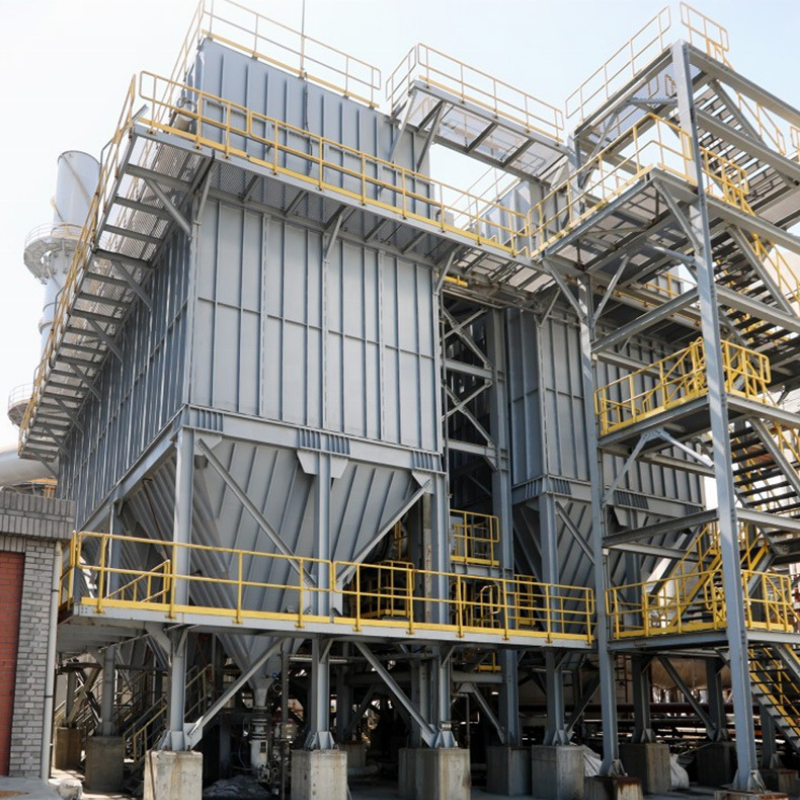
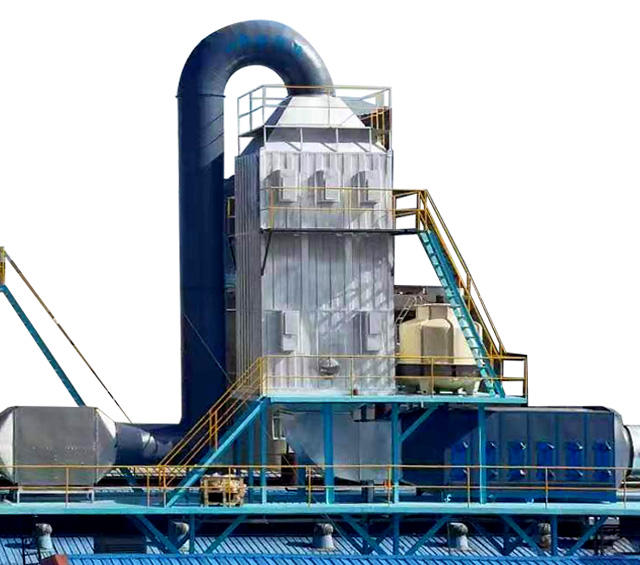
ZZMCB series — pulse jet bag filter
Model span: ZZMCB-24–ZZMCB-440. Flow (reference): 2,000–31,680+ m³/h. Certified layouts issued per project.
| Model | Flow (m³/h) | Area (m²) | Bags | Bag size (ref.) | Pulse valves | ΔP |
|---|---|---|---|---|---|---|
| ZZMCB-24 | 2,000 | 18 | 24 | Ø130×2500 | 4 | 1,500–2,000 Pa |
| ZZMCB-48 | 4,000 | 36 | 48 | Ø130×2500 | 6 | 1,500–2,000 Pa |
| ZZMCB-96 | 8,000 | 72 | 96 | Ø130×6000 | 12 | 1,500–2,000 Pa |
| ZZMCB-180 | 15,000 | 135 | 180 | Ø160×6000 | 18 | 1,500–2,000 Pa |
| ZZMCB-280 | 24,000 | 216 | 280 | Ø160×6000 | 28 | 1,500–2,000 Pa |
| ZZMCB-440 | 31,680 | 288 | 440 | Ø160×6000 | 44 | 1,500–2,000 Pa |
ZZJD series — wet electrostatic precipitator
Model span: ZZJD-5K–ZZJD-60K. Flow: 5,000–60,000 m³/h.
| Model | Flow | Footprint | Anode tubes | Voltage | Current | Power |
|---|---|---|---|---|---|---|
| ZZJD-5K | 5,000 | Per design | 19 | 72 kV DC | 100–200 mA | 5.5 kW |
| ZZJD-10K | 10,000 | Per design | 38 | 72 kV DC | 150–300 mA | 11 kW |
| ZZJD-20K | 20,000 | Per design | 76 | 72 kV DC | 200–400 mA | 15 kW |
| ZZJD-30K | 30,000 | Per design | 114 | 72 kV DC | 250–450 mA | 22 kW |
| ZZJD-40K | 40,000 | Per design | 150 | 72 kV DC | 300–500 mA | 26 kW |
| ZZJD-60K | 60,000 | Per design | 211 | 72 kV DC | 300–500 mA | 30 kW |
Filter bag materials
| Media | Temperature | Application | Life |
|---|---|---|---|
| Polyester (PE) | <130°C | General dust | 2–3 yr |
| Polypropylene (PP) | <90°C | Chemical dust | 2–3 yr |
| Nomex | <200°C | Elevated temperature | 3–4 yr |
| P84 | <260°C | High temperature | 4–5 yr |
| PTFE | <280°C | Corrosive / high T | 5–6 yr |
| Glass fiber | <280°C | High temperature | 3–4 yr |
Equipment materials
- Carbon steel — standard, economical
- Stainless 304 / 316 — corrosive or hygienic duty
- FRP — acid/alkali wet sections
Setting configuration and structure
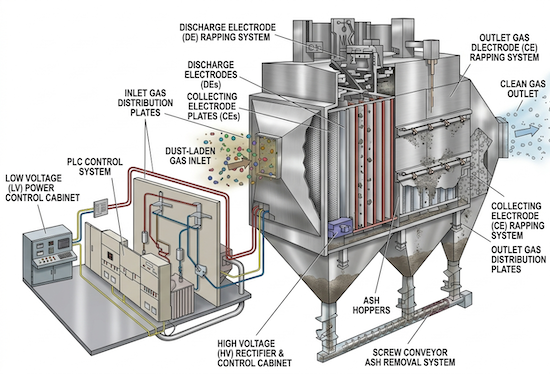
Pulse bag structure
- Upper box—clean air plenum
- Middle box—tube sheet, bags, cage, pulse headers
- Lower box—hopper, level / discharge, support
- Ancillaries—PLC, pulse valves, instrument air 0.4–0.6 MPa, rotary valve / screw, differential pressure
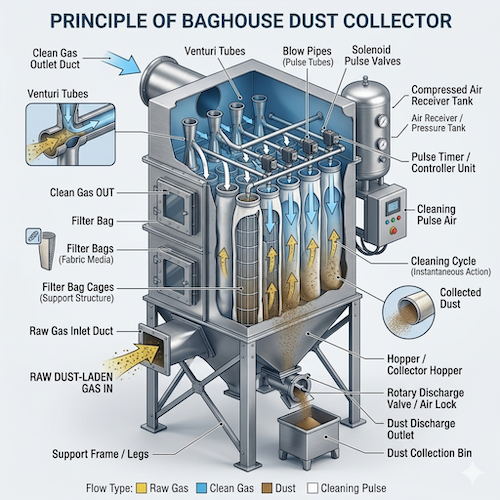
Wet ESP structure
- Shell—SS or FRP, view ports
- Electrodes—cathode frames / wires, anode tube bundle, insulator chest
- HV supply—regulated DC negative, ~72 kV class
- Collection zone—sump, flush water, sludge / blowdown
Standard configuration comparison
Both lines include casing, capture system (bags or ESP field), cleaning (pulse or wash), PLC/monitoring, dust or effluent removal, safety (vents / grounding / interlocks), and maintenance access.
Installation types
- Single unit — typically ≤30,000 m³/h class
- Parallel — higher flow or redundancy
- Multi-stage — high inlet loading
- Combined — cyclone + bag + ESP; cooling + bag; scrubber + WESP
- Polishing — final WESP or fine filter after bag
Material selection
Main structure
- Coated carbon steel 2.0–3.0 mm — general duty
- SS304 1.2–2.5 mm — corrosion
- SS316 — aggressive chemistry
- FRP 6–10 mm — wet acid/alkali
Filter media (bag)
PET, PP, aramid (Nomex-class), P84, PTFE, and glass per temperature and chemistry (see table above).
WESP electrodes
- Stainless cathode and anode components — 5+ year target with wash water quality control
- Ceramic insulators — HV standoff
- Shell SS304 or FRP — 10+ year in wet service with proper water treatment
Selection criteria
Temperature, chemistry, abrasion, explosibility (NFPA / ATEX strategy), budget, access for bag change or tube cleaning, and electrical safety grounding for ESP.
Technical characteristics
| Parameter | Pulse bag | Wet ESP |
|---|---|---|
| Collection efficiency | ≥99% | ≥95% |
| Particle size (typ.) | 0.3–100 µm | 0.01–100 µm |
| Pressure drop | 1,500–2,000 Pa | 300–500 Pa |
| Gas temperature | <280°C (media-limited) | <80°C |
| Face velocity / gas speed | 1–3 m/min (filter) | 1–2 m/s (field) |
| Power | Fan + small controls | HV + fan + pump |
| Water use | None (dry) | Required |
Bag media properties (typical)
- Cut-point near 0.3 µm class for fine finishes; permeability 200–400 L/m²·s (product-dependent)
- Tensile >1,500 N/5×20 cm (specimen basis); chemical resistance per fiber
- Service life 2–6 years depending on dust and cleaning energy
WESP operating window
- 72 kV DC class; current 100–500 mA range by size
- Mist removal ≥95% reference; power 5.5–30 kW (table)
- Hardware life 10+ years with water chemistry control
Design envelopes
Bag: inlet dust <1,000 g/m³ (with precollection as needed), T <280°C, RH <85%, face velocity 1–3 m/min, pulse air 0.4–0.6 MPa, ΔP 1,500–2,000 Pa.
WESP: T <80°C, mist loading <5 g/m³ (typical pre-scrub), saturated gas acceptable, 1–2 m/s, 72 kV DC negative, ΔP 300–500 Pa.
Safety
- Explosion venting / suppression / isolation for combustible dusts; grounding and bonding
- Fire and spark detection where specified; pressure relief; ESD interlocks
- Lock-out/tag-out; verified ESP ground grid before energization
Main features and advantages
Pulse bag highlights
≥99% efficiency on fine dust, automatic pulse cleaning, material recovery, flows 2,000–31,000+ m³/h, PLC control, compact modular rows.
WESP highlights
≥95% mist/smoke capture, submicron range, low ΔP (300–500 Pa), corrosion-resistant wet shell, long electrode life, suited after quench/scrubber.
Cost themes
Bag: medium CAPEX, low–medium OPEX, bag replacement cycles. WESP: medium–high CAPEX, water and power OPEX, minimal moving parts in field.
Technology comparison
| Technology | Efficiency / size | ΔP |
|---|---|---|
| Cyclone | 70–90%, >10 µm bias | 500–1,500 Pa |
| Pulse bag | ≥99%, 0.3–100 µm | 1,500–2,000 Pa |
| Wet ESP | ≥95%, 0.01–100 µm | 300–500 Pa |
| Combined train | ≥99.5% target, full range | Sum of stages |
Application fields
Industries
Cement and concrete batching, mining and crushing, metal fabrication, rubber and tire, tobacco, food, chemicals, grain, pharmaceutical, electronics soldering, smelting, textiles, woodworking, power (fly ash), glass, brick and ceramics.
Pollutant capability
Coarse through ultrafine dust, smoke and mist, ferrous/non-ferrous metal fines, silica/cement/clay, organic and food dusts, carbon black, fly ash—efficiencies per tables above.
Reference projects
| Project | Flow | Application | Year |
|---|---|---|---|
| Guangzhou Huantou Fushan | 80,000 m³/h | Waste treatment | 2022 |
| Zhanjiang Qingfang Environmental | 30,000 m³/h | Paper–plastic dust | 2023 |
| Guangzhou Zhongyu Mining | 10,000 m³/h | Mine dust | 2022 |
| Beihai Lizhun Electronics | 8,000 m³/h | Electronics dust | 2022 |
| Foshan Dancao Flour Mill | 10,000 m³/h | Food dust | 2021 |
| Shandong Laiyang Hazardous Waste | 10,000 m³/h | HW dust handling | 2023 |
| Foshan Xiongli Aluminum | 20,000 m³/h | Aluminum fume | 2018 |
| Guiyang Leidafu Thermal | 5,000 m³/h | Thermal equipment smoke | 2022 |
| Zhaoqing Fengkai Building Materials | 30,000 m³/h | Kiln smoke | 2022 |
| Yunfu Luoding Zinc Smelting | 10,000 m³/h | Zinc smelting fume | 2020 |
Applicable standards
- GB 16297-1996 — Air pollutant emission limits
- GB 3095-2012 — Ambient air quality
- GB 9078-1996 — Industrial furnace emissions
- GB 13271-2014 — Boiler emissions
- Provincial DB limits and sector BREF-style guidelines
Pretreatment
- Cool or dilute bag inlet to media limit; control RH <85% for conventional bags
- Reduce loading with cyclone or pre-scrubber; manage sticky or hygroscopic dust
- Combustible dust hazard analysis; corrosive gas compatibility for metals and bags
System integration options
Combined systems
- Cyclone + bag (high loading); bag + WESP (fine/mist polish)
- Cooler + bag (temperature); scrubber + WESP (hot mist)
- Multi-compartment bags; full train cyclone + cooler + bag + ESP
Control functions
- PLC — timed or on-demand pulse; WESP current/voltage regulation
- ΔP, temperature, fault alarms; remote monitoring optional; data logging; emergency stop
Maintenance guidelines
Routine plan
- Daily — ΔP review
- Weekly — hopper level, WESP water quality / flow
- Monthly — bags, pulse valves, ESP electrodes and HV cabinet
- Quarterly — system walkdown; bags 2–6 yr; ESP wash as fouling dictates
Best practices
Bag: Track ΔP trends; maintain 0.4–0.6 MPa instrument air; inspect bags on shutdown; keep spare sets; train on combustible dust SOP.
WESP: Monitor kV/mA; keep wash nozzles clear; verify ground continuity; inlet <80°C; log inspections.
Care — do and do not
| Recommended | Avoid |
|---|---|
| Follow OEM manuals; correct bag for chemistry; inspect on schedule; ESP grounding; gentle cleaning; dry spare storage. | Exceed temperature; wet conventional bags; ignore ΔP rise; energize ESP without ground check; abrasive washing; corrosive upsets without material review. |
Numeric values are typical engineering references; certified layouts, explosion protection studies, and stack tests are issued per project.