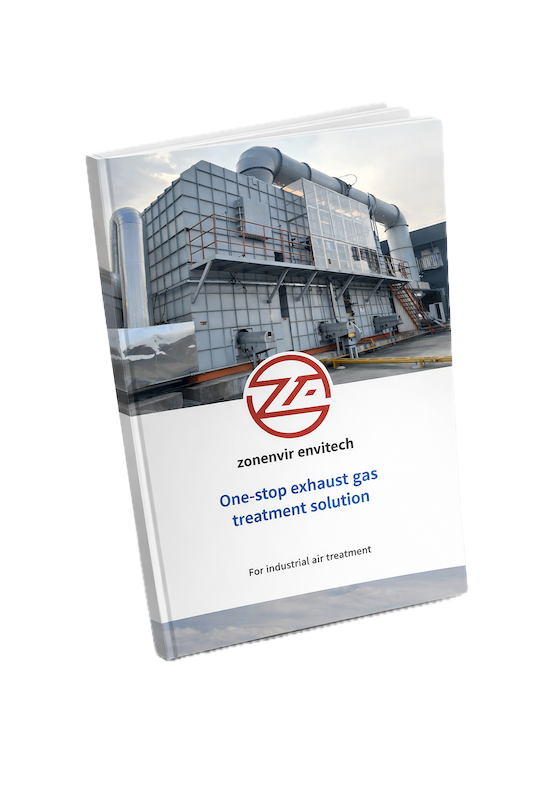
Zhengzhou Enviro Solutions is the international brand of Guangdong Zhengzhou Environmental Protection Technology Co., Ltd., a Foshan-based manufacturer and engineering provider for industrial waste gas treatment systems. We configure equipment for VOCs, acid mist, odors, dust, smoke and corrosive exhaust according to the actual process conditions—not a one-size-fits-all removal claim.
For faster selection, send airflow, pollutant composition, inlet concentration, temperature and the required outlet limit with your enquiry.
Choose the treatment process by pollutant and operating condition
The same pollutant name can require a different system at another plant. Our first step is to define the source, concentration range, airflow variation, chemistry, safety constraints and compliance target.
| Pollutant / source | Typical examples | Candidate process | Key selection point |
|---|---|---|---|
| Acid and alkaline mist | HCl, H₂SO₄, HF, NH₃ and pickling or plating exhaust | Packed wet scrubber or cyclone-hybrid spray scrubber | Selected by gas solubility, reagent chemistry, corrosion risk and mist loading. |
| VOCs | Coating, printing, chemical and solvent exhaust | Activated carbon, zeolite concentration, catalytic oxidation or RTO | Selection depends on concentration, airflow, composition, temperature and safety limits. |
| Odor | H₂S, NH₃ and biodegradable wastewater or process odors | Biofilter, chemical scrubber, carbon polishing or ionization | Humidity, biodegradability, variability and required redundancy drive the treatment train. |
| Dust, smoke and aerosol | Dry particulate, sticky dust, fumes and fine liquid droplets | Pulse-jet baghouse, wet scrubber or wet electrostatic precipitator | Particle size, resistivity, moisture, temperature and fire risk determine the separator. |
| Laboratory exhaust | Variable acid, alkaline and organic fume-hood streams | Corrosion-resistant ducting, scrubber, dry filter and carbon stages | A source-by-source review avoids incompatible chemicals entering the same treatment stage. |
Published equipment ranges from our supplied catalog
These figures describe standard model ranges in the current manufacturer catalog. They are useful for early screening, but they are not a final guarantee: pressure loss, residence time, reagent demand, fan duty and emissions performance must be recalculated for each project.
PP spray scrubber towers
- Catalog airflow
- 2,000–100,000 m³/h
- Published resistance
- 500 Pa
Biological deodorization units
- Catalog airflow
- 1,000–100,000 m³/h
- Published resistance
- 600–800 Pa
Activated carbon adsorption boxes
- Catalog airflow
- 2,500–60,000 m³/h
- Published resistance
- 300 Pa
High-energy ion deodorization units
- Catalog airflow
- 2,000–75,000 m³/h
- Published resistance
- 260–300 Pa
Wet electrostatic precipitators
- Catalog airflow
- 5,000–60,000 m³/h
- Published resistance
- Project-specific
Information required for equipment selection
A quotation based only on duct diameter or total airflow is incomplete. Provide the following inputs so the engineer can define the process train, materials, fan duty, controls and operating cost.
- Airflow for each operating condition (m³/h)
- Pollutant names and inlet concentrations
- Gas temperature, humidity and particulate loading
- Required outlet limit or applicable local standard
- Operating hours, batch cycles and expected variation
- Corrosive, flammable, explosive or condensable components
- Available footprint, duct route and stack arrangement
- Site voltage, frequency, installation location and climate
- Destination country, delivery scope and commissioning needs
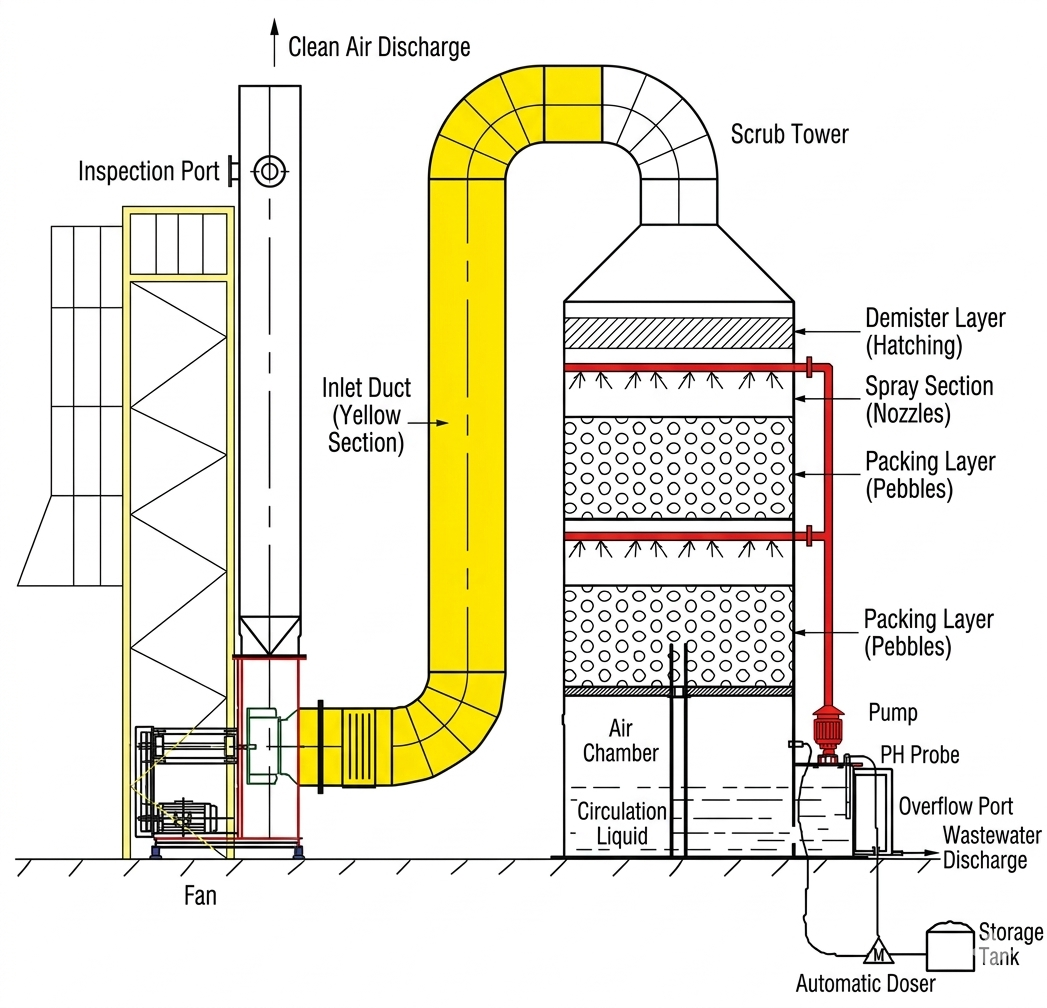
Typical engineering scope
Source review, process selection, equipment and duct sizing, corrosion-resistant material selection, controls, fabrication, delivery documentation, installation guidance and commissioning support.
Browse treatment equipmentPublished industrial project references
The supplied catalog lists 115 project references across VOC, odor, dust, laboratory, acid-gas and wastewater applications. The examples below are catalog records, not independent performance certifications; detailed inlet and outlet test reports can only be supplied where the underlying record and publication permission are available.
New-materials VOC treatment
Three published design duties: 40,000, 800 and 35,000 m³/h, with wet pretreatment and VOC treatment stages.
Review the solutionMunicipal WWTP odor treatment
Published project record: 15,000 m³/h using a fan, spray scrubber, activated-carbon box and biological tower.
Review the solutionBrick-kiln flue-gas treatment
Published design basis: 250,000 m³/h with two-stage wet desulfurization and stated SO₂/PM targets.
Review the solutionEngineering and procurement guides
Use these guides to prepare a comparable RFQ, review the proposed process, diagnose common operating problems and convert the selected design into factory and site acceptance checks.
Treatment system selection
Map pollutant properties and operating conditions to scrubber, adsorption, biological, oxidation or dust-control processes.
Read the guideAirflow and fan sizing
Build the source register, operating scenarios, pressure-loss schedule and fan duty point.
Read the guideChina manufacturer RFQ checklist
Compare suppliers on one design basis, with materials, evidence, guarantees and delivery scope made explicit.
Read the guideFAT and commissioning checklist
Inspect fabrication, controls and documentation before shipment, then verify airflow and performance on site.
Read the guideFRP fan troubleshooting
Diagnose low flow, high current, vibration, bearing heat, corrosion and startup faults from measured system data.
Read the guideWet ESP selection
Specify inlet conditions, collecting fields, corrosion materials, wash systems, controls and acceptance criteria.
Read the guideLaboratory exhaust design
Separate laboratory sources and connect hood capture, treatment, fan duty, stack design and commissioning.
Read the guideLeachate-station odor control
Control fugitive odor with covers, balanced extraction, biological treatment and evidence-based polishing.
Read the guideScrubber liquid distribution
Coordinate nozzles, packing, recirculation and demisters to prevent dry zones, flooding and carryover.
Read the guideFan installation and system effect
Protect the selected operating point through correct inlet geometry, duct support, alignment and testing.
Read the guideWork with a China-based waste gas treatment equipment manufacturer
Guangdong Zhengzhou Environmental Protection Technology Co., Ltd. is located in Foshan, Guangdong. Zonenvir is the company's international-facing brand for engineered air-pollution-control and corrosion-resistant ventilation equipment. We support equipment-only supply and project-specific treatment trains for overseas industrial sites.
Waste gas treatment system FAQ
Which system should I use for industrial waste gas?
There is no universal process. Airflow, composition, concentration, temperature, humidity, safety risk and the required outlet limit must be reviewed together. A wet scrubber may suit soluble acid gas, while VOC exhaust may require adsorption, concentration or oxidation.
Can you quote from airflow alone?
We can give an initial equipment range, but a responsible proposal also needs pollutant data, temperature, operating schedule, corrosion and explosion risk, site voltage, footprint and discharge requirement.
Do you supply individual equipment or a complete treatment line?
Both scopes are available. The supply can cover a scrubber, biofilter, adsorption unit or fan, or an engineered train including pretreatment, core treatment, ducting, controls and installation guidance.
Are catalog airflow ranges guaranteed for every application?
No. Catalog figures identify available standard sizes. Final airflow, pressure loss, materials, media volume, reagent demand and performance requirements are confirmed in the project-specific technical proposal.